LATEST POSTINGS
Showing posts with label Reflections. Show all posts

Wednesday, 28 December 2022

Death Rituals

One of the sad parts of my job is having our patients die. It is inevitable when working in healthcare, but it isn't something I was prepared for when I started the job.

Because I'm not a doctor I never imagined that doing an administrative role as a receptionist would mean that sometimes I would have to come into contact with death, and it's not easy, not easy for anyone, but it also impacts on us non-clinical staff.


In the past week we have had three patients pass away. On hearing of the death of one in particular, it made me cry a little because I had come to know this person for the brief moments (sometimes not so brief if the doctor was running late) while they sat in the waiting room and we would chat and laugh. We talked about family and Christmas plans and how they were coping with a tough health diagnosis, and it became a warm, superficial relationship that somehow didn't feel superficial because we shared so much and I grew to like them and care about them. 

And then they died. 

It dawns on you that you'll never see them again. They're never going to walk through those doors and pass the time of day with you ever again. They knew your name and you knew theirs, and now that is gone.

Processing a death in a medical centre as an administrator felt like such a cold, heartless procedure when I first started in this job.

Upon hearing of the death, you immediately have to attend to it. It stops texts and recalls and notifications going out to the person's phone who has died, which could be distressing to the family. I understand why it has to be done but at first it seemed cold and heartless, ruthless even.

But I've become accustomed to it now, and now I consider it an honour. One of the last administrative tasks that is performed for a life that saw medical events and procedures and physical challenges and a documented relationship with a doctor. 

I've made it into my own little ritual. When I was a child and teenager, I used to keep a book with all the names of people I knew who had died. I don't know why I did it, I just thought it was a nice thing to do, to remember them.

Processing a death at work feels like something similar.

First you have to un-enrol them from the healthcare system and record the date of death. You have to pull their enrolment form with their signature from the files and it often has a photo attached to it, and this brings back memories of your own encounters with that person. I like to think about those times for a bit before I move onto the next stage. I like to think and remember who they were and the times I interacted with them, and I think of their family and the sadness they must be going through as they process a sorrow far deeper than mine.

The final stage is finding all their medical history. Where I work, this means going into the dark storage room and finding the folder that holds the tangible evidence of their birth, life and now death. It is all bundled together and placed in a file.

I write their full name carefully across the top with the date of death, and then I carry it to another place where it is stored for 10 years. This is a legal requirement. Writing their full name feels important. Like a statement saying this person lived. This person had a name, a family, a connection with people and community and they were somebody.

It's such a small job. A small, last ritual. An important one, but such a small one, but I like the privilege of carrying it out - one of the last services I can do for them. 


Sunday, 18 December 2022

Listen to the Rhythm of the Rain

It has rained here all week.

Perhaps it is the ancient Scots blood in me, born down from my ancestors that acclimatised to gloomy, dark weather living up in the north of Scotland for all those centuries, that makes me feel comforted in rain. Rain has always felt soothing to me and this week I have been grateful for it calming my soul because this week has been difficult for me on a few fronts.


Justice has always been my driving force, although I didn't come to realise that until late in life. Learning that I love justice and hate injustice is what led me to study sociology and understanding how the world works, how it turns, how sociologists are passionate drivers for change in society. A passion for a just world and a believer that one person can impact the world for better. To break the darkness with light. 


But this week it has been tested because I had unfair and untrue accusations said to me, from both my workplace and an extended family relationship and in the past it would have been in my nature to cower and submit and give in and quietly walk away, letting it go, absorbing that shame and injustice, or as Erin Hanson says in her beautiful poem, that I "gave them what they wanted..... gave them life with endless sun."

Standing up for yourself is not always very easy. It is stressful for me. It still impacts negatively on my health but I have learned better how to deal with it and how to mentally process it.  I have learned how to confront bullies. I have learned what happens when you do. I've learned not to be controlled by others. 

I have learned that it is not always the healthy way to stay silent. 

Sometimes, though, it is necessary to be silent (such as dealing with personality disorders as I mentioned in my last post) and knowing the difference is part of this journey.

I've had to do both this week - confront unfair accusations and also to ignore the raging of a narcissist.  In doing so, working through these challenges, I realise how much I've grown personally and spiritually. Able to stand in the confidence of my belief systems and values and integrity, while partnering with God through life to grow closer to Him and lean on His strength through difficult times, to be sheltered by Him and heard.

So, I've been grateful for the rain this week, that has brought a calmness to my day, a solace of cool, quiet, refreshment, a steady presence and reminder that nothing beautiful would ever grow if it wasn't for the rain. 

Here is Erin Hanson's poem in full. You can find her wonderful work here on Instagram.


Sunday, 11 December 2022

This Game of Narcissistic Revenge

Einstein once said:


Weak people revenge.

Strong people forgive.

Intelligent people ignore.


I've been thinking of our royal family this week. Well, in fact, for many weeks since, but especially this week as that terribly self-indulgent documentary is released by Netflix.

If you've ever experienced life with a narcissist and you've been following the royal drama that is Harry and Meghan, you may have started to feel something awfully familiar in the narrative coming out of Montecito, but not been sure what it was. 

"By the pricking of my thumbs, something evil this way comes." A quote by Agatha Christie.

I recognised it.

I didn't see it at the beginning. Like most of Great Britain and the Commonwealth, we saw Meghan as a breath of fresh air in the royal family, an exciting addition, young, modern and with Prince Harry being one of the most popular British princes at the time, there was huge bonhomie and elation to see him finally find someone and be happy. What an amazing asset they could have been. What an incredible platform for change and good they could have had. Britain welcomed her with open arms.

Mark Jones, CC BY 2.0 <https://creativecommons.org/licenses/by/2.0>, via Wikimedia Commons


How sad are the words, could have been and could have had. 

I could write entire essays on what my opinion is on this situation, and some wonder why I am interested at all, why does it matter to me? Why do I take up brain space thinking about these people I've never met and who don't live in my country.

It matters because the royal family is tied up with our democracy. The greatest (though flawed) form of democracy that exists in our modern world in my opinion. New Zealand has a legal binding to the UK, from our historic dealings with them, and apart from that, when you grow up learning about the royals and seeing them on everything it feels like, as Harry rightly said in the Netflix documentary, they feel like an extension of our own family. The Royal family are non-political and as Queen Elizabeth kept reiterating, they are there to serve the public. The royal family do an incredible amount of work with charities and awareness around issues impacting society. 

I, for one, will not stand by and be silent in this audacious attack against our democracy and our hard-working royal family by an American production company and two people who feel grieved against their own family.

I wasn't going to watch the Harry and Meghan show on Netflix. I was steely determined to NOT watch it, but in the end, I had no self-control and pressed play the minute it dropped onto our screens. It's like watching a train-wreck in slow motion and I don't watch because I have some kind of pleasure in seeing it happen, I watch because I care about what happens to our royal family and especially to the Prince and Princess of Wales who do not deserve the vitriol or underhanded comments being levelled at them. They are hard workers and appear to be very genuine, caring, kind people trying to do their best in a role that has been thrust upon them and who will one day make a splendid King and Queen. 

I do want to talk about revenge.

Meghan, and it must be said, Harry too, seem to insinuate a lot with barbed remarks. It's quite a cowardly way of getting revenge, especially knowing that the royal family can't fight back. We used to call that cowardly behaviour when I was growing up. Nowadays its called being a bully.

But regardless of all the rhetoric, today I'm not here to discuss the sad downward spiral of Harry and Meghan's character in the eyes of the world, I'm here to talk about narcissism and to raise a question I've been mulling over for a few weeks now.

There has been a lot of talk online and in news articles and social media from royal commentators and authors and in-the-know people about what King Charles III needs to do. Most people are saying, even calling for the King to strip them of their titles, to not 'keep calm and carry on' as has been the tradition of the royal family in the face of criticism, but rather now is the time to speak up, the time to defend themselves.

I've been thinking about this and thinking back to my own experiences with an alleged narcissist, in a public arena, albeit a smaller one than this world stage the royals are on. What would I do? 

If I was in a position to give advice what would my advice be?

Dealing with a narcissist is not something to be undertaken lightly. Responding to a narcissist is like walking across broken glass in bare feet - full of dangers and hidden threats as well as obvious threats. 

At first I thought that for sure the royal family would have to say something in their own defence this time. The amount of lies and fabrications brought against them are staggering (well documented in other places). The audaciousness of Meghan and Harry is staggering. The complete un-self-awareness is staggering.

But the general rule with narcissists is to ignore. The term widely used for this is to 'grey rock'.


What is a grey rock? It is stone. It is dull, it is immovable. It doesn't talk. It doesn't move. 

Should the royal family ignore this time?

Yes. They should. 

The advice is solid to 'grey rock', ignore the narcissist. To give them any response at all is to give them pleasure. To respond is to give fuel. If the royals want this to go away, the best advice is..... ignore. A narcissist cannot stand to be ignored. 

Narcissism is an extreme selfishness but it is also an extreme low self worth. The narcissist believes deep down in their subconscious core that they are worth nothing, so they manufacture, manipulate, strive to prove they are worth something, so if you ignore them, you are showing them that their worst fears about themselves are valid and it does two things....

1. It sets them on a path of revenge at you.

2. It ultimately silences them and they will move on to their next fuel for validation (or next victim).

They may still occassionally fire arrows at you, but those arrows are never as effective as they once could have been.

As it appears in this documentary, Harry and Meghan's obvious hatred and jealousy of the royal family practically oozes out of their pores. You have to know how a narcissist works to see it. Don't be fooled by the jaunty narrative these two would have you believe. It's there in the snide little remarks......

Example:

"Even when Will and Kate came over, and I met her for the first time, they came over for dinner, I remember I was in ripped jeans and I was barefoot. Like, I was a hugger, I've always been a hugger. I didn't realise that that is really jarring for a lot of Brits. I guess I started to understand really quickly that the formality on the outside carried through on the inside." quote by Meghan Markle in the Netflix documentary, 'Harry and Meghan'.

Not only is this culturally insensitive, it also demonstrates a disrespect for other people's personal boundaries. It also makes out as if the Prince and Princess of Wales are cold, unfriendly people.

It's there in the barbs against members of the royal family. 

Example: the very disrespectful demonstration of her supposed courtesy to the late Queen Elizabeth II.

It's there in 'H'. Narcissists devalue. You are an extension of them. You have no identity. By calling Harry 'H' is devaluing his identity, it reduces him to a letter of the alphabet.

It's there in body language. It's there in the manipulation of the media and its viewers. It's there in the exploitation of the word 'racism'.

Revenge is an inevitable step in a narcissist's cycle. It's the final shot that a narc has to shoot. It's when they know the game is over, they have lost the game, and there is nothing more they can do, so they go for broke. They fire everything they have at their target, the enemy of their power to control; in this case, the Crown; the King and the Prince and Princess of Wales and by extension, the people of Great Britain.

When a narcissist reaches this step, they have metaphorically dug their own grave and are about to fall into it.

So, I say again to anyone listening.

Ignore.


Sunday, 4 December 2022

A Tiny Shift

This summer, I'm working on a book. 

Because of the nature of it, I'm finding I'm being drawn back to old arts centred around home and family. It's more of a challenge now to focus on home, because I work 4 days a week and I'm studying, but there must be something in the air that is making me turn my focus back onto this. 

I find as I get older that I take comfort in old, familiar things and old, familiar faces. It is probably because we as a family have been through so much in the past 10 years and I reach for peace and safety and familiar. It is possible to crave that and yet still have ambitions, as I do with my study and future. A check list, if you like, for the second half of my life. The things I want to do are things that I have chosen for myself and even at my age I still have dreams.

I think I know what precipitated this shift.

At the beginning of the year we visited my home province in Marlborough for a summer holiday. It was one of the loveliest holidays filled with warm, sunny days walking through old familiar streets and haunts in Picton, the seaside town and Blenheim, my hometown, where old friends I've known all my life still live, and a remnant of relatives. Once it was full of my grandparents and cousins and parents and great aunts and uncles, but we grew up and moved away and grandparents passed away, but the area holds so many dear memories for me, still full of atmosphere and fragrance and textures and sounds and somehow this year I felt like I wanted to hold onto that forever.

I'm writing a book about this very special part of New Zealand and my memories of growing up as a Marlborough girl.  A collection of recipes and stories and connection with the people and places of this province. It is a nostalgic project and I'll be invoking the food of the 1970s and 1980s that left indelible an imprint on our collective family history as well as generational food passed down from the matriarchs.

As part of the writing and creative process, I have decided to incorporate weekly videos for my youtube channel. I plan on doing this every Sunday. Food is such an intrinsic part of who we are and is intertwined with the stories of our lives, so while I am more of a writer than I am an orator or camera person, I felt it was important to record the process of creating a book about life and memories and connection. These videos will reflect the person I am - the introvert and lover of quiet in a world that clamours for attention and noise. It's a place for other introverts - to slow life down and enjoy the beauty around us and to remember and reflect on what is important - connection with people and with places.

I would be interested to know what you think and your own thoughts around this subject.

Sunday, 23 October 2022

My Introverted Life in the Goldfish Bowl of a Waiting Room

Four years of human nature training. That's what I call it. 

I have learned more about human nature in the four years of doing this job as a Medical Receptionist than I learned anywhere else.

I was trained by one of the best in the industry and I'm pretty confident when I say that, even though I don't know any other medical receptionist trainers. She is someone with such a knowledge of people and human behaviour that after I interviewed for the job and was successful, I asked her why she knew I'd be good for the role, because I literally had nothing going for me unless 20 years as a stay at home mum or a school hockey club secretary counted. Her reply: "I liked you." Coming from someone who has a radar like a policeman, was and still is, one of the best compliments I've ever received. My husband Rob is like this too and I always put it down to his experience as a probation officer and the work he does with convicted criminals. You get to see the worst and the best of humanity, and being in a medical centre is not dissimilar. Over the years, you develop an intuition about people and between the lady who trained me and my husband, I'm yet to see them get it wrong. 

Being a medical receptionist is the kind of job where you have to be a people person if you want to be good at your job. Now, I would have said I was the kind of people person described by Elizabeth Bennet in Pride and Prejudice: 

I am introverted. I love my space and the quiet for internal, personal reflection. I hate being put on the spot for my opinion or thoughts. I hate being asked questions without preparation. I'm not good at small talk - I abhor it. I hate the telephone and I hate being around people all day long and I hate being on 'show' - like a goldfish in a goldfish bowl. All of these qualities are not suitable for a medical receptionist. Every day, every encounter with a patient is a question, or someone wanting something from me. Small talk is the lifeblood of a doctor's waiting room, "How are you today, Mr P," "isn't it a beautiful day outside?" or "when is the rain going to stop," or "I love your beautiful cardigan, Mrs S," all day long, and the telephone! I have never liked talking on the phone. My friends know this about me, because I never call. The phone is a huge part of being a receptionist and in a doctor's surgery it literally never stops. I had to jump in the deep end on this one when I first started the job. I was terrified of the phone and I hated it, "just suck it up Rachel and deal with it." Four years down the track, I still don't like the phone, but at least I usually have the answers now for any caller or know who to pass it on to if I don't.

My office is in the middle of the waiting room, and it does feel like a goldfish bowl some days and I get comments on my clothes or jewellery which I don't mind, or old men telling me I "look great in those pants" which I do mind.

In spite of all of these things not fitting with my introverted nature, I find that this is one of the most interesting jobs I have ever had and that it suits my personality. I used to think being a nurse aid when I was 17 at a convalescent hospital for geriatrics was one of the most interesting jobs I'd done, but this one tops that even, probably because it's less physically demanding work. 

I had reason to think about this lately when considering my job after one of our patients in their late 80s said to me randomly as they were leaving the other day, "don't you ever leave this place." They meant it as a compliment and I took it as one, ("I won't if you won't," I replied cheekily), but because of the introverted, reflective thinker I am, I had to think through why they said that to me. What was it about me, an introverted, melancholic, suspicious minded, hater of telephones and crowds, that made them say that?

I'm interested in people. I am a people person. I can't believe I'm admitting that, but it's true.  I'm interested in their lives and who they are and what makes them tick. 

After four years of doing this job I have realised that to be an effective receptionist in a community practice, you have to be a people person. The job is managing people all day long and sometimes this takes a delicate balance, especially when it comes to people's health and medical needs, so knowing the patients, knowing who they are and their story, is an important, if not vital part of this job. 

But what is a people person? I've had plenty of extroverts tell me that they are a people person, but they wouldn't know the first thing about getting past that superficial layer of social niceties and conversations. Their idea of being a people person is being around people, but it's for themselves, not for that person, and if you're like that in this job, you'll just end up pissing people off.

So what makes a genuine people person? I think it doesn't matter if you consider yourself an extrovert or an introvert, what matters is genuinely caring about another person, and being interested in them. The superficiality of relationship is more than just a 'hi, how are you?' "How was your day?" "Have a great day!" in a loud voice with a big smile (shudder).

A genuine people person will take the time to get to know you, who you are, what makes you tick, will remember your story. Always - it's not about me, it's about you. 

It's knowing, in my job, when a person walks in the door, what to talk about with them, be it their Christmas plans, their house being built, their grandchildren, their kid's first day at school, or the new job they started recently, or whether to actually just leave them alone in silence. It's knowing how unwell they are that day, because they're not their usual self.

I like working in a practice in my own community. I like running into our patients at the grocery store and passing the time of day or waving out on the street when I'm out walking my dog around the neighbourhood. It makes me feel a sense of belonging in this community, and I think it helps them too when they come to the doctor to have a familiar face and voice, someone who cares about them, even if it is just the receptionist, especially when they're not well and needing care. 

It's a job I love and care about and I've been so grateful for the education in humanity that it has given me. 


Friday, 14 October 2022

Republic vs. The Crown

No other country in the world does ceremony like the British.  As we've seen recently with the funeral of Queen Elizabeth II, the formalities surrounding this was spectacular, moving and sobering, fitting for a state funeral and reflected the sadness and grief of the nation. 

This week it was announced that next May, 2023 we will have another ceremony in the state occasion of crowning the new King and Queen in a happier event, so more uniformed soldiers, gold coaches, spectacular music and clothes and crowns to look forward to.


I personally love that our own country of New Zealand is linked with the Crown, especially when the jewels and music and parades are brought out - it's a wonderful link with a rich and interesting history, and it truly would be a shame to do away with the hundreds of years of tradition, even though we think of ourselves as so 'modern' now and don't need this. It's true, we don't have to parade our Kings through the streets on horseback as they might have done in medieval times in a display that served as both an introduction and assertion of power in a time when Kings held political power. We no longer have to go to battle to the death for our Kings to sit on the throne, but by committing to a formal ceremony we are not only reminding the realms of the importance of the Crown, but the validity they give to our democracy. 

The Westminster democracy that our country's political system runs on, is one of the best in my opinion. 

My reason for this thinking is because republics - even with checks and balances in place still gives room for power-hungry people to jostle for position and it attracts people who want power, leaving it wide open for corruption and difficult for anyone who does not have huge wealth. Historically, republics tend to eventually descend into chaos and implode. The Roman Empire gives us an example of this. Ambitious men hungry for power began to not care about the rules and the laws, putting themselves forward as saviours, making up the rules, mocking the democratic processes and democracy descends into autocracy. 

Imagine if we were adopting such a republic system in New Zealand. Our current Prime minister Jacinda Ardern would be President Ardern. There would be no Governor General. In actual fact, New Zealand operates from the best of this system, because of our distance from the UK, the neutralness of the Royal Family and their non-political stance which makes them figureheads rather than rulers, and we function fairly independently and on our own anyway. I get irritated with people who argue that we need to become a republic because we need to grow up as a country. Grow up to be what?  

As a student of Sociology and a student of Forensic Psychology, I hope to channel my education and ultimately research into this area of power - and explore the science behind power and why certain people seek powerful positions. I can tell you that I have learned that all world leaders need to have a degree of narcissism - or a kinder way of putting it would be - self-belief confidence - to become a leader of a nation, be that a President or a Prime minister. On the psychopathy scale (which is different from narcissism), the top 4 historic leaders with strong psychopathic traits included King Henry VIII and Adolf Hitler. No surprises there perhaps. We also looked at the last fifty years of American leaders which was more a matter of who didn't have psychopathic traits than who did. While it sounds terrible to have psychopathic traits, it's actually not all bad. Some psychopathic traits can be beneficial in certain circumstances and an advantage to a nation who needs someone confident enough to make difficult and sometimes quick decisions.

The Westminster system works as a true democracy because no ruler - neither the Prime minister nor the Sovereign can have total power. One yields to the other and the Royal Family exist only at the consent of the people, for the people as our late Queen Elizabeth II said, 

“I have in sincerity pledged myself to your service, as so many of you are pledged to mine. Throughout all my life, and with all my heart, I shall strive to be worthy of your trust.” - Speech on her Coronation Day, June 2, 1953.

The position of Sovereign is inherited, which means the baton of power in the Crown is not sought by personal ambition, unless you're a malevolent second son; however, if second sons yearn for the power of the Crown - and we have seen a few famous second sons - Henry VIII was a second son, Prince Andrew, Prince Harry, they can only take the crown through a family tragedy or a dastardly deed. It has been done in history before (not by Henry VIII though, his was due to his brother's untimely death through illness) - and sometimes second sons are the ones who don't want the crown and end up with it - as the Queen's father did. 

But regardless of these reasons listed above, the main reason I think New Zealand needs to stay with the British Crown and the Westminster style of democracy is because of the Treaty of Waitangi (Te Tiriti o Waitangi).

The Treaty of Waitangi is unique to New Zealand and Great Britain and though its history is long and complicated, it was signed in 1840 between some Maori iwi (tribes) and the British Government representing the Crown (Queen Victoria at the time). 


There are legal disputes over the language used in the treaty which I won't get into here, but because of our agreement with Great Britain and the Crown, the Treaty of Waitangi protects Maori. If we do away with the Crown and our legal obligations under the Treaty of Waitangi, what becomes of those safety nets for Maori? In 1995 Queen Elizabeth II apologised to Maori for the injustices done to Maori after the Treaty was signed, among those land confiscations which has had a significant detrimental impact on the wellbeing of Maori, because they were displaced and lost their way of life. 

What followed after this apology were financial settlements from the Crown towards Maori iwi and is ongoing today as Maori still dispute many of the historic injustices. There is recognition that the Treaty of Waitangi was used against Maori, but there is also acknowledgement now that the Treaty obligations can be honoured, must be honoured. Maori strive to always remind the New Zealand government of this. The Treaty is sometimes an 'inconvenience' to government, but because of that sacred pact between Maori and the British Crown, it must be adhered to. It is a unique agreement and I believe safeguards Maori against exploitation, further oppression and racism. 

To do away with the Treaty would mean one of two things: either the newly formed presidential government would have to give Maori what they want - full sovereignty and the authority to govern themselves or they would have to enter the Treaty of Waitangi into the new constitution and this could be tied up for years in debates and Maori would need (have) to be key players in all decisions.

I recognise that Maori ideally would like their sovereignty back, and in an ideal world this would be my preference, but I don't trust people in power to stay altruistic and the Treaty of Waitangi under the Crown, gives us a safety net. 


Thursday, 29 September 2022

These Games of Thrones - Part 2

It was a strange feeling for me that hours after publishing Part 1 of this series, the news was announced to the world that our Queen Elizabeth II had died. 

Great Britain and the realms and the Commonwealth (of which New Zealand is a part) entered into 10 days of mourning and King Charles III ascended to his role of King.

What this past week has shown me and confirmed to me, is that our political system with the Crown as the constitutional head, is the greatest form of democracy in the world, bar none. In the next month, I will write a post on why I think New Zealand needs to stay with the monarchy and not become a republic.

Much of my belief stems from strong opinions around the Treaty of Waitangi, but also, paramount above even this, is the core belief that human nature craves power and control. There is something within the depths of all mankind that cannot help himself but given the chance will elevate him or herself, or when he finds himself treated as a god, to enjoy this, to bask in this, like a pig in muck, and countries choosing to become a republic is sometimes the means of doing this, lofty ideologies descending into self-centred political manoeuvrings. But more about that next month.

When thinking about the Westminster system, it got me thinking about how it all began. I believe there were two pivotal points in history that had long-lasting impact on our political system. Those two points of change in British history began with King Henry VIII, and then later with Oliver Cromwell's dealings with King Charles I. You might also be surprised to learn the the British monarchy has been abolished in history more than once, but somehow they survive and come back from this.

As a result of these changes, the Crown is now 'above politics'. It gives the countries who are under the Crown leadership that tries to bring people together. In the great jostle for power and control, under the Westminster system, nobody can really have total power. The Sovereign can't. The Prime Minister can't. Isn't that a good check and balance for true freedom? Given mankind's propensity for absolute power and control, I think it is.

With the passing of Queen Elizabeth two weeks ago, Great Britain and all her realms and those who have her as Head of State (as we do in New Zealand) are now going through a transition period of change-over. I've always thought one of the most incredible moments in history must be that moment as the Sovereign dies, as their spirit leaves their body, attention immediately turns to the heir presumptive. In our case, Prince Charles, now King Charles. The transition is immediate. When Victoria became Queen, she wrote about the moment in her diary, 

"I was awoke at 6 o'clock by Mamma, who told me the Archbishop of Canterbury and Lord Conyngham were here and wished to see me. I got out of bed and went into my sitting-room (only in my dressing gown) and alone, and saw them. Lord Conyngham then acquainted me that my poor Uncle, the King, was no more, and had expired at 12 minutes past 2 this morning, and consequently that I am Queen."

This painting depicts the constitutional act of 'kissing hands" - effectively an acknowledgement of the transition of power, a declaration of that transition from the dead monarch to the new.

Painting by Henry Tanworth Wells, 1887.


So how has lust for power and control manifested in the British Royal Family? How has history been impacted by it? How did it change from absolute power to what we have now - a balanced sharing of power. Judge for yourself whether these games of thrones still continue. 

I want to start with the War of the Roses in the 15th century - which was one of England's most bloody and unsettled times, but was crucial in setting up the system we now have. It is actually a wonderful love story also (after the War of the Roses ended).

It began in 1455 and ended in 1487. 
It's an incredibly messy, complicated, brutal, tragic story with way too much killing. I have spent the last three weeks researching it and I still don't feel that I fully grasp everything that went on.
I do remember briefly covering it in history class in high school, but it was delivered in such a boring way all I could remember about it from then are the two rose emblems. So let's start there.


Basically, to break it down and over simply it, these related families, the Lancasters and the Yorks - cousins and descended from King Edward III (House of Plantagenet), both wanted the Throne of England. So they kept fighting each other in the hopes that one would stay alive long enough to be all powerful, or perhaps wipe out every living soul from the opposing family that would be the war that ended all wars.

The King in 1455 was King Henry VI.

Born at Windsor Castle, to put this into perspective he is our current King Charles' 15th Great Grand Uncle.
I want to say that royals named Henry are a bit of a mixed bag as far as character and success. I'm not sure I'd be naming my child Henry, if I was descended by any of these kings, but it is definitely a name that runs in the family (our modern Prince Harry is actually Prince Henry). 
Henry VI - a Lancastrian - was King twice, such was his tumultuous life. Probably the most memorable thing about this soft-spoken, gentle (some say feeble) King is that he married Margaret of Anjou, who became a force to be reckoned with, within the royal family and in the War of the Roses. She was behind many of the Lancastrian uprisings. Ultimately, she was triumphant, but history has a funny, twisted way of rewriting victories such as hers, as you will discover eventually, if you follow my series.

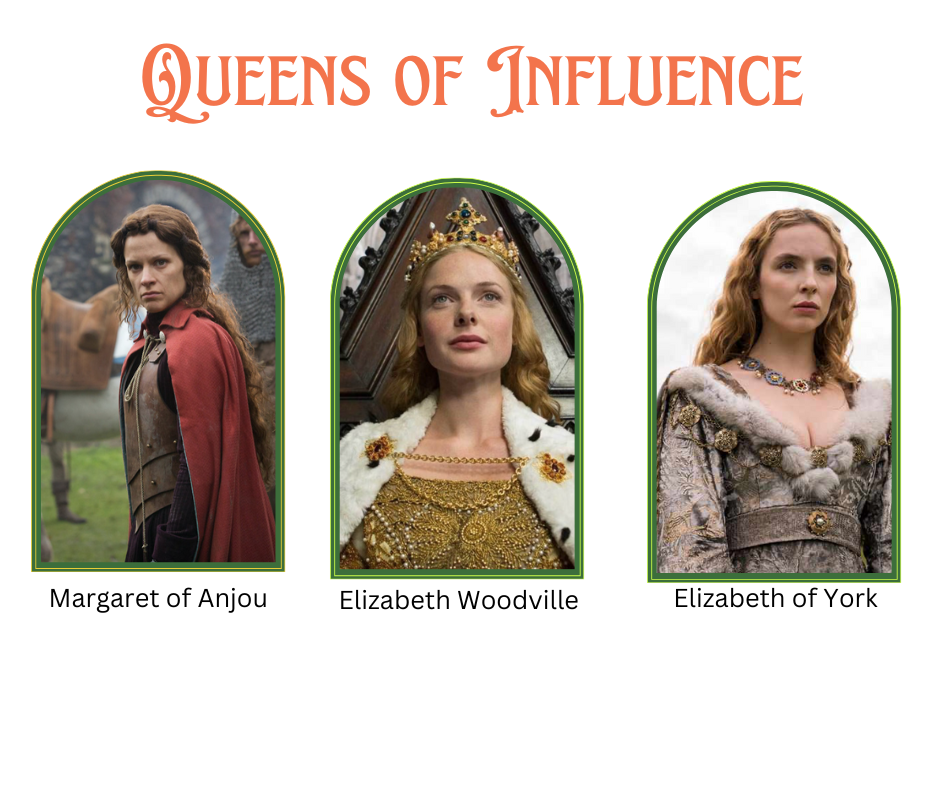
In a largely patriarchal society, where women were commodities in the relentless manipulations for power, it is interesting that many of these women, especially in the time of the War of the Roses, were powerful and clever and key to many events. Margaret of Anjou, Elizabeth Woodville and then her daughter Elizabeth of York each had a significant part to play in the War of the Roses.

These Queens, the powerhouses behind the Wars of the Roses - were reportedly beautiful women, so I feel that their medieval portraits don't really do them justice, so here are their 'modern' portraits, as portrayed through the popular dramatised series about their lives.  The White Queen (Margaret of Anjou portrayed by Veerle Baetens and Elizabeth Woodville portrayed by Rebecca Ferguson, and The White Princess, Elizabeth of York portrayed by the incomparable Jodie Comer) - dramatised versions of Philippa Gregory's novels about these women. They are excellent portrayals, I think.  Notice in some of the original art, Elizabeth of York who married Henry VII holds a white rose, and in the original art (below) Henry VII holds a red rose. If that's not a spoiler alert, I don't know what is!


But returning to the reason we are here - the Kings.
We began with King Henry VI. We end with King Henry VII, and a few other Kings and wanna-be kings in between, and Warwick the Kingmaker, a York cousin who featured prominently across the lives of the Kings and who if he was alive today, could probably go on Oprah and whinge about the royal family. 

King Richard the III and King Henry VII were the last two Kings to fight for their throne on the battlefield. 

Spoiler Alert: The Red Rose wins. No wait. The White Rose wins.
Ah - that is the plot twist at the end of this tale.


Image Credit: Bill Sibly (image has been modified).


I want to do a whole blog post on King Richard III, because as it turns out, he is a much maligned King. He is known through history as the worst King England has ever had, but many of his supposed wicked deeds are unproven and possibly the work of the propaganda machine from the Lancasters at the time. Imagine that! Propoganda in the 1400s! It is fascinating! His body lay undiscovered for 500 years and was recently found. A movie is coming out about it soon!


This is a brief summary of some of the key characters during that terrible, bloody time in England known as The War of the Roses.

If any of this has piqued your interest, I highly recommend this YouTube documentary series on the War of the Roses, because I have found it too complicated and I'd be writing about it forever, to try and unpack everything that went on during this time, and this series breaks it down, makes it understandable and is a rip-roaring watch!


Back To Top
Copyright © 2014 tiny ordinary days. Designed by OddThemes